






Firestop systems tested to ASTM E814 (UL1479) have two ratings. the F Rating represents a minimum amount of time that an installation has been tested and shown to prevent the propagation of fire. Most people can readily understand this portion of the rating. the T Rating, however, is a different and more complicated story. the T Rating is often disregarded or overlooked.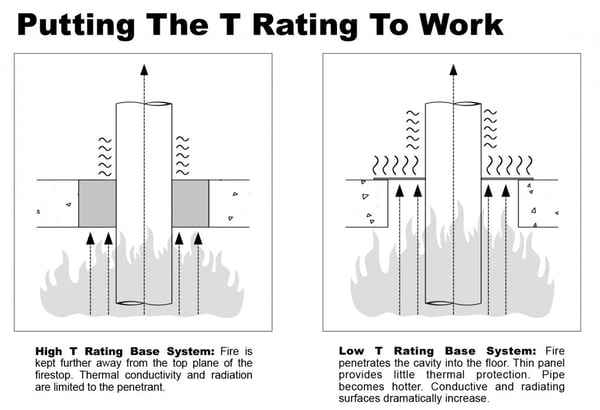
By definition it is a measure of the time it takes for any thermocouple on the unexposed side (the side of the assembly away from the fire) to reach a temperature 325°F above the temperature of this thermocouple prior to the start of the test. thus it is a measure of thermal conductivity.
ASTM E814 was developed in the early 1980’s to address the need for a test to specifically address the needs of firestop ping. Prior to this standard, unofficial variations of ASTM e119 were used to evaluate firestop methods and materials. This test however, was designed to evaluate the fire-resistive properties of walls and floors and if followed to the letter of the law–tended to be too restrictive in its requirements concerning thermal conductivity. the limitations it prescribed made it practically impossible to penetrate a rated barrier with a metallic penetrant.
E814 Made T Ratings Optional: ASTM E814 was written in a fashion that would let the question of thermal conductivity become an option. temperatures would be monitored and recorded but would be reported separately from the F rating. thus the T rating was born. What the members of this ASTM committee couldn’t address in this standard, was the method of utilizing this useful bit of information. It has become a political football in code circles being punted back and forth by special interests groups.
The Intent of the T rating: It is important to understand the intent of the t rating. ASTM E119 requires a random placement of thermocouples but specifically requires in addition to these, the placement of thermocouples at any point which might logically be a point of excessive heat transfer. thus a metallic fastener or a steel beam penetrating on the unexposed side would require a thermocouple. the standard in most cases, provides a limiting temperature rise of 250°F on average but provides an additional 75°F mar gin for any single thermocouple. thus that wall with the beam mentioned above, could have a 250°F rise on the wall itself and 325°F on the beam. this was the logic being carried over
into ASTM E814.
The E814 commit tees essentially recognized that penetrants could and would run hotter than the 250°F rise and applied the e119 exception language to the penetrant. The requirements were intended to create some breathing space for the penetrant, not for the firestop seal or the surrounding construction. Thus, if a 6” steel pipe is penetrating a 12” hole, the intent is to allow some margin for the pipe itself.
Date And Time
Event Location/Form
Event Address
Tags
Share With Friends